
Lift up your eyes!
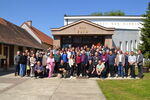
From April 16 to 19, 2026, Serbia-North Macedonia-Albania Annual Conference of The United Methodist Church (UMC) gathered in Kisac (Serbia).
The UMC in Serbia has maintained a retreat and training center in Kisac for many years. Its spacious facilities – combined with heartfelt hospitality and delicious, traditional local cuisine – provided an excellent setting for the Annual Conference gathering.
Around 60 people from the three countries Serbia, North Macedonia, and Albania attended: pastors, lay members, guests, and translators. The latter were particularly important, as the linguistic diversity of this Annual Conference is vast: six languages were spoken during the opening worship service alone: Serbian, Slovak, Macedonian, Albanian, English, and German. And the diversity of the UMC in the three countries—which is both a source of richness and a challenge – also encompasses the different histories, influences, and cultures of the local churches and individuals. Against this backdrop, unity is not a given but requires targeted measures to foster community.
After last year’s debate over constitutional amendments to the worldwide United Methodist Church had also sparked friction and conflict, this year’s efforts toward unity and harmony were palpable on all sides. And what was particularly striking: all formal organizational matters played a secondary role. Reports and procedural issues, which often take up a great deal of space elsewhere, were only briefly addressed. The numerous reports from the various areas of work were also accepted for the most part without further questions.
Instead, the focus was on mutual dialogue, building connections across national borders, mutual encouragement, and developing joint projects. To this end, the conference divided into four working groups, such as Children/Youth, Women, and Social Ministry. These working groups, however, did not exclusively discuss their specific areas but – from their respective perspectives – kept the church as a whole in view and developed, in some cases, quite concrete ideas and initiatives. While these discussions certainly highlighted the diverse situations in the individual countries, questions regarding the relationship between existing congregational work and new missionary initiatives, or between social ministry and evangelism, are relevant everywhere. And they ultimately raised the question of what actually defines the church.
There were significant personnel changes at the leadership level. Superintendent Wilfried Nausner, who, together with his wife Jean, had served with extraordinary dedication in Albania for 18 years, was succeeded by Gjergj Lushka. Daniel Sjanta, who had served as superintendent in Serbia for eight years, was bid farewell along with his wife Elena. His successor will be Novica Brankov. Gratitude for the service of the two superintendents and their wives was expressed in many diverse and touching ways. The actual handover of office will take place in both countries in the course of this year.
During Sunday’s closing service, the two new superintendents were blessed. In addition, Nikola Jovanoski from Prilep, North Macedonia, was welcomed as a local pastor. No fewer than five different musical groups – ranging from a classical choir to a youth band from a Roma congregation – contributed to the joyful service in a church filled to capacity. The conference congregation was encouraged not to let the challenges of the present paralyze them, but to look up and trust in God’s faithful presence and loving help amid the very different realities of life in each country.
Author: Pastor Christoph Klaiber, Reutlingen (Germany) / Edited by: Urs Schweizer, Zurich