
Between diversity and a common future
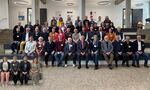
European executive bodies of The United Methodist Church met in Reutlingen (Germany) to discuss cooperation, diversity, and common perspectives for the future.
"We discovered what unites us - and where we are different," said the participants. These words sum up the meeting of the European executive bodies of The United Methodist Church (UMC) from March 12-14, 2026. For the first time, all the executive committees of the three European regional conferences came together for a joint meeting - at Reutlingen School of Theology (Germany).
More than 50 leaders from all over Europe took part - from countries ranging from Scandinavia to Germany, Eastern Europe and the Mediterranean region. The regional conferences include countries such as Norway, Finland, and Ukraine as well as Germany, Switzerland, Hungary, and Albania.
Kick-off with a spiritual perspective
The first day of the conference began with a communion service. In her sermon, Erika Stalcup, a pastor in Lausanne (Switzerland), focused on a fundamental perspective: "What we can give, we have first received - from God and by His grace." With this, she set a tone that shaped the subsequent discussions.
On the same day, retired Bishop Patrick Streiff put the current situation into historical perspective. In an overview, he traced the development of Methodism on the European mainland - from its beginnings in the 19th century through the time of the central conferences to today's regional conferences. The current issues were thus placed in a broader context.
Listening to the soft voice of God
The following day began with a morning devotion by Werner Philipp, bishop for Germany regional conference. Based on the story of the prophet Elijah, he reminded the participants that God does not appear in storms, earthquakes or fire. "God's voice is quiet - and yet it points the way," he emphasized. For many, this became a key thought for the further deliberations - because it emphasized the importance of listening to God.
The following morning, another spiritual impulse set a special tone. Pastor Yulia Starodubets, Ukraine, led the devotion and gave an impressive account of her experiences in the war. She described the stresses of everyday life - fear, uncertainty and exhaustion - and at the same time how people find comfort and support in faith, even those who previously had no connection to the Christian faith. At the center was the biblical word from Jeremiah 29, verse 11: God's promise of "future and hope". In the midst of the current situation, this promise became a supporting thought for many - and a sign of hope that transcends national borders.
Insights into the regions of Europe
In the further course of the conference, representatives of the three regional conferences presented their respective situations. The situation in Germany was presented by Bishop Werner Philipp together with Michael Löffler. In addition to a historical review, the focus was on current developments. In Germany, the UMC is operating in an environment that is increasingly characterized by secularization and a noticeable loss of importance of the institutionalized Christian faith. At the same time, many congregations are changing due to migration and international diversity. New forms of community are emerging, while familiar structures are coming under pressure. Both are part of the current reality of the region and challenge the Church to rethink its mission under changed conditions.
Bishop Knut Refsdal reported on Northern Europe, the Baltic States, and Ukraine. He described a region caught between strongly secularized societies and a new search for spiritual orientation. "We feel a great longing for new vitality and hope," he said. At the same time, he made it clear how important the churches in Ukraine have become: as places of help, support, and hope in the midst of war.
Urs Schweizer, assistant to Bishop Stefan Zürcher in Zurich (Switzerland), presented the region of Central and Southern Europe. He highlighted the great geographical and cultural diversity of the region, which stretches across two continents and 13 countries. The communities live in very different social situations - always as a small minority. The already mentioned development is also evident in this region: the church is less naturally anchored in society than it used to be. The common concern to be present as "ambassadors of hope" in the respective situations is emphasized all the more.
Diversity as a shared experience
The diversity of Europe was a common thread running through the discussions. It manifested itself in different cultural, political, and religious contexts. At the same time, it became clear that it was precisely this diversity that opened up new perspectives and made it possible to learn from one another.
Observations of the guests
This was also the perception of observers. Pastor Kah-Jin Jeffrey Kuan, United Methodist theologian and former President of the Claremont School of Theology in the USA, who is now active in international leadership and advisory tasks for the UMC, was impressed by the European situation. The diversity within the regions is clearly visible - and at the same time an opportunity for the common task of the Church.
Leaders of the European Methodist Council, who attended the conference as guests, contributed this perspective from their own point of view. Heather Morris, General Secretary of the Methodist Church in Ireland, and Doug Godfrey-Swanney, Methodist Church in Great Britain, described how they had experienced themselves not as observers, but as part of the community. They saw the invitation, which explicitly emphasized that the UMC is not the only Methodist Church in Europe, as a courageous sign.
Shaping the future together
In addition to the reports, the main focus was on the question of how cooperation between the three United Methodist regions in Europe could grow in concrete terms. Experiences were shared and ideas collected in working groups and open exchange formats. It became clear that what was experienced at this conference as a community of faith should not remain at the leadership level. There is a desire to bring these experiences more strongly into the congregations. For example, partnerships between congregations across national borders were discussed. They could help to get to know each other, pass on experiences and explore new paths together.
One concrete result of the meeting is the establishment of a working group to draw up proposals for future cooperation between the regions in Europe. The bishops and other representatives from the three regional conferences are involved. A next joint meeting is already planned for 2027.
A common path begins
At the end, the conclusion was clear: the meeting helped to build trust, better understand differences, and develop common perspectives. Or, as Jeffrey Kuan put it: the similarities are stronger than the differences.
The meeting in Reutlingen therefore does not mark a conclusion, but a beginning. The challenges remain - in the individual countries as well as for the European part of the UMC as a whole. At the same time, it is noticeable that there is a growing will to continue on this path together - and to consciously remain in trusting dialog with the other Methodist Churches in Europe.
Source: Michael Löffler, Theological Director of the Church Chancellery of the UMC in Germany