
"We are not alone!" - Methodist bishops visit Ukraine
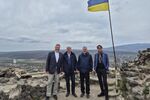
Three Methodist bishops traveled to western Ukraine to visit UMC congregations and meet people who have been living in war for years. Their conclusion: active love on the ground is a strong sign of hope.
It is the small gestures that remain: A common prayer, a smile in the youth center, a table where refugees tell what they have experienced. From March 26 to 30, 2026, the Methodist bishops Stefan Zürcher (Central and Southern Europe), Werner Philipp (Germany) and Knut Refsdal (Northern Europe, Baltic States and Ukraine) visited congregations and projects in Transcarpathia and Lviv in western Ukraine. They wanted to send a signal of solidarity - and experience for themselves how the UMC in Ukraine is creating hope despite the war. The Methodist pastor and superintendent Oleg Starodubets accompanied the bishops together with his wife Yulia.
Why this visit?
At a meeting in the fall of 2025, Bishop Knut Refsdal told them about his plans to visit, recalls Bishop Stefan Zürcher. "In conversation, Bishop Werner Philipp and I quickly realized that if all three of us went, it would send a strong signal." They wanted to show through their visit: The people of the UMC in Ukraine are not alone.
Bishop Stefan Zürcher's episcopal territory includes the UMC in Poland, Czechia, Hungary, and Romania. "Since the beginning of the war, Methodists in these countries have accompanied refugees and also supported the work in Ukraine with humanitarian aid transports." Now it was time to travel to Ukraine themselves - and meet the people on the ground. It was Bishop Stefan Zürcher's first visit to the country. Bishop Werner Philipp was also there for the first time, while Knut Refsdal traveled to Ukraine for the third time since his election as bishop.
Encounters that leave their mark
The program was packed: from Uzhhorod to Lviv, from youth centers to refugee shelters, worship services, celebrations, and discussions with refugees. In Lviv, the bishops met a lively, young congregation. On Friday evening, they were there for meetings and a simple worship service. "There were 25 to 30 young people there," said Bishop Stefan Zürcher. Some of them had grown up in Lviv and the surrounding area, others had fled from eastern Ukraine to the comparative safety of the west.
The cities visited by the bishops had grown massively due to the influx of internally displaced persons. Around one million people now live in Lviv, almost a third more than in 2022. "In Uzhhorod, the number of residents has even tripled, from 120,000 to 350,000, which naturally brings with it corresponding challenges." This is not just about the required living space, but also about cultural differences between the west and east of Ukraine.
Creating safe spaces
The bishops also visited the "Lighthouse" youth center in Uzhhorod during their trip. Many of the teenagers and young adults who meet at the center, which is organized as an NGO, are internally displaced persons. The work began in September 2025. "It's about giving teenagers and young adults a place where they can be and be safe. They can simply come here - and belong," explains Bishop Stefan Zürcher.
In Uzhhorod, the leaders of the UMC also run two shelters for internally displaced persons. Simple rooms and a communal kitchen have been set up in an old communist building in the middle of the city. Refugees find a more comfortable home in the former hotel "Under the Castle".
Refugee work as a testimony for God
One poignant moment was the encounter with refugee women there. "One woman said: 'The fact that the Methodists are here and giving us this opportunity to stay is a proof to me that God exists,'" says Bishop Stefan Zürcher. Very few of the refugees had any previous contact with a church, let alone the UMC. "And here they experience it: The Methodists accompany us. They make sure that we get what we need. This active love has a very strong effect."
War in everyday life: normality and trauma
Despite the war, life in Lviv seems almost normal at first glance, says Bishop Stefan Zürcher. "The cafés are full, the streets are lively." Nevertheless, traces of the war are omnipresent: destroyed houses, military cemeteries, memorial plaques. "In Lviv, we saw a house that had been hit by a drone just days before. The windows of the neighboring church were broken. But everything had already been cleaned up."
The bishops felt the tension above all in the talks. "Yulia Starodubets told us that she didn't ask the women about their stories. That could retraumatize them." Many of the refugees come from hotspots such as Bakhmut, Mariupol or Kharkiv. "When you listen to them, you realize that they have very difficult stories."
Bishop Knut Refsdal was impressed by the sight of the cemetery in Lviv. "It was moving to see the graves of so many young men - and to know that these are only the fallen from this region." For Bishop Werner Philipp, too, it was a moment in which the horror of war was palpable: "When it's no longer just numbers, but names and faces, the war becomes tangible."
What remains? Connection and hope
"The visit showed us how important a physical presence is," summarizes Bishop Stefan Zürcher. "The people there felt it: We are not forgotten. The fact that we came as bishops was a sign of solidarity for them." The reality of a global church is not just an abstract idea but is experienced as concrete closeness in a difficult situation. The trip had encouraged him to continue seeking such encounters. They showed that Christian solidarity does not end at borders and that help does not always have to be loud in order to have an impact.
Author: Sigmar Friedrich, Zurich / Switzerland
Photo: Bishops Werner Philipp (left), Stefan Zürcher (2nd from right), Knut Refsdal (right)