
Journeying Together in Faith and Service
From June 5 to 7, 2026, nearly 50 people gathered in Prague for the District Conference and the subsequent Annual Conference of The United Methodist Church (UMC) in Czechia.
The UMC in Czechia comprises around 20 congregations, with a total of about 1,500 members and friends. These figures are more or less the same as last year’s – but they only reflect part of the reality. Through a wide range of diaconal activities, men and women in local churches and diaconal institutions also reach out to many people who are not part of the church and are therefore not included in these statistics. These activities include kindergartens and programs for students, meal distribution for homeless people, addiction prevention and support for those struggling with addiction, centers for mothers and their children, as well as prison and hospital chaplaincy.
Reports from the local churches are a regular feature of the conference program. In these reports, the central role of the Sunday service was just as evident as the work with children. It is impressive to see the love, creativity, and dedication – mostly from volunteers – with which this work is carried out. Bible studies, prayer meetings, and Alpha courses, one of them held jointly with the Roman Catholic Church, also have a firm place in the local churches’ program. Other activities aim to engage people with their diverse interests and talents; this often overlaps with activities outside the congregation: music, dance, sports, creativity, but also celebrating festivals and strengthening community in a wide variety of ways.
There are two special congregations in Prague. On the one hand, there is the English-speaking congregation, where people from many different countries who have made Prague their home for a shorter or longer period of time come together. While it was regretted that this congregation currently does not have its own pastor, there was also hope that this would change soon. On the other hand, there is the Agapé congregation, where services are held in Russian, Ukrainian, English, and sometimes Czech.
The situation in Horni Pocernice, on the outskirts of the Czech capital Prague, is also unique. A local church meets here that also maintains ecumenical contacts. Above all, however, the UMC owns a large property in this location that is already being used as a diaconal center and is set to be further revitalized. The purchase of an additional property (albeit one with significant contamination) is also currently under discussion. In the future, this location is intended to become an even stronger center of community and multifaceted support.
The fact that the UMC in Czechia is on the path to becoming an autonomous church was addressed in the report of the Commission on Church Order. The process is challenging, and there are still numerous questions to be answered – including those regarding the future relationship between the autonomous church and the UMC, and how to handle individuals who wish to remain members of the UMC. However, there was a palpable constructive willingness to find the answers to these questions through good cooperation.
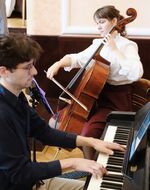
This year’s Annual Conference concluded with a worship service with Holy Communion, also attended by members and friends from the Prague congregations. People from different generations provided the musical accompaniment, and two men were ordained as deacons during this service.
The UMC in Czechia continues its journey together – diverse, committed, multilingual, in faith and in service.
Source: Regula Stotz, Switzerland / Urs Schweizer, Assistant to the Bishop
Photo © UMC CZ: Musical diversity during the closing service