
A Future Full of Hope
From May 7 to 10, 2026, the Annual Conference gathering of The United Methodist Church in Hungary and Romania was held in Szolnok and Budapest (Hungary).
“For I know the plans I have for you,” declares the Lord, “plans to prosper you and not to harm you, plans to give you hope and a future.” This 2026 motto of the UMC in Hungary, taken from Jeremiah 29:11, also served as the theme for this year’s gathering of the Annual Conference and highlighted some of the hopeful spirit that characterizes the UMC in Romania and Hungary.
A priority concern for the Church is the two Methodist educational institutions in Budapest (Hungary), the “Schola Europa” and the “Forrai School.” Two “school pastors” serve as important points of contact for the students and teachers—that is, for people who in many cases would likely not be reached by the church’s “traditional” programs. The decision regarding the potential purchase of a portion of a building and the expansion of the “Schola Europa” has been delegated to the church board; there, the advantages and uncertainties are to be weighed against one another—also in light of the changed political situation.
In Romania, the UMC is currently registered as a non-governmental organization. As such, it operates in a dynamic, flexible, innovative, and goal-oriented manner. However, it has now also reached the necessary size to attain the status of a religious corporation. This step is scheduled to take place in 2026.
The diverse work in Cluj-Napoca (Romania) is of great importance. The “More Than Boxing” program has been very successful. It reaches over 150 adolescents and young adults, and the program was even awarded a municipal prize in recognition of its efforts in the areas of inclusion and diversity.
However, the organization’s activities are fundamentally designed to serve society; for example, the monthly women’s meetings for women of diverse backgrounds, where they discuss issues related to life and faith. Work with people from Ukraine also continues in this spirit: in addition to Romanian language courses, dance, music, and other creative activities are offered.
In Comsesti (Romania), the work with Roma children and youth in particular is bearing much fruit. An important aspect of this is educational work, which includes, for example, extracurricular support for students and programs for apprentices. The Hungarian-speaking Roma communities in western Romania are also on a promising path of learning and community building. Among other things, there were two women’s gatherings attended by over 100 women.
It is also encouraging to see how much financial responsibility is being taken on in both countries. Nevertheless, the UMC continues to rely on financial and personnel support. During the gathering, heartfelt thanks were expressed for all this support and for all prayers.
As part of the general reporting, the major changes within the Committee for Women’s Work became evident – changes that were also accompanied by visible and palpable emotions. The Theological Committee, in turn, addressed many topics, even though it consists of only four members. Thus, issues ranging from education to interdenominational cooperation were discussed.
During a festive evening, Gabor Szuhanszky was honored upon his retirement after 50 years of service, particularly for his contributions to the Martha-Maria Senior Home in Budakeszi (Hungary). Additionally, thanks were expressed to Laszlo Khaled for his ten years of service as superintendent. Musicians from the Roma community in Alsozsolca provided the musical accompaniment for the joyful celebration.
During the closing Sunday service in Budapest, Zoltan Kovacs was blessed for his service as the new superintendent of the UMC in Hungary, and many words of greeting from representatives of other denominations underscored the high regard in which the UMC in Hungary is held far beyond the boundaries of its congregations and ministries.
Author: Regula Stotz, Basel (edited by Urs Schweizer, Zürich)
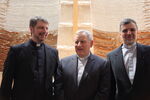
Photo: Three Hungarian Superintendents: (fltr) Zoltan Kovacs (as of 2026), Istvan Csernak (1996-2016), Laszlo Khaled (2016-2026)
Photographer: Marcell Sztupkai