
Light and warmth in a cold world
What applies figuratively to many places on this earth is also a painful reality in Ukraine in the true sense of the word - it is dark and cold. Next month, the destructive war will enter its fifth year...
"Yes, the winter is really cold and hard for Ukraine this year. Added to this is the fact that many power and heating systems have been destroyed." This is how Yulia Starodubets, a leader of The United Methodist Church (UMC) in Ukraine, who lives in the west of the country and offers a place of refuge and help to internally displaced persons, puts it. Thanks to her contacts, she knows: "In all the country's larger cities, people are once again suffering regular power cuts."
Petr Húšť, an aid worker from the Czech Republic, who has traveled to Ukraine dozens of times with relief supplies and recently returned from this embattled country, puts it even more drastically: "In Kyiv, there is only electricity for two hours a day and temperatures have dropped to -20 °C." This is not because the relevant supply facilities are dilapidated. Rather, Russian troops are taking advantage of the bad weather and targeting sources of electricity and heat. The consequences of this are obvious: "People are freezing. Water and heating pipes are bursting. Stores, restaurants and cafés are closed. Payment terminals are not working, and you can't withdraw money from ATMs." Switching to alternative heating methods is not possible because, for example, it is simply not possible to buy wood in Kyiv and the surrounding area - everything is sold out. One consequence of this is that parents in Kyiv are sending their children to family members and friends in other regions. At the same time, Russian troops are stepping up their attacks. According to the aid worker from the Czech Republic, this is causing existential tensions: "Parents are asking themselves: what happens if we die, who will take care of our children?"
What will the future bring? Millions of people have now left Ukraine and found not only temporary protection in European countries, but also a new home - and a job opportunity to earn their own living. In countries directly or indirectly bordering Ukraine, such as Poland, the Czech Republic, Hungary, and Romania, congregations and individuals of the UMC are also offering help in an impressively diverse way. They do this in terms of accommodation, work, and language, but also with regard to leisure activities and social integration. And psychological and pastoral care are particularly important. Many of the refugees may be unharmed on the outside - but not on the inside. There are now also people from Ukraine who have found a new spiritual home in many UMC congregations. Will these people stay? Or is the country of their refuge only a temporary home after all, and their hearts are still in their homeland - and filled with the hope of returning? Bożena Daszuta, a member of the church council of the UMC in Poland, put it this way in a recent conversation: "Those who still have a husband and father in Ukraine will perhaps return one day, indeed they are already traveling to Ukraine regularly. Those who do not or no longer have these family ties will probably stay here."
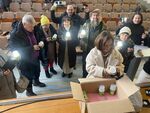
Thanks to an initiative by a very committed engineer, people from a UMC congregation in southern Germany have produced around 150 solar lamps. Almost 100 of these have already found their way to Ukraine via a UMC congregation in eastern Hungary. Dozens more are waiting to be brought to Ukraine via Poland and the Czech Republic. And even more lamps will follow if road conditions permit and if there is not only a need in Ukraine, but also appropriate distribution facilities.
In a time of constant power cuts, such solar lamps are not only a cost-effective and practical lighting option. They also bring light into the darkness in a figurative sense. Because they are a symbol that the people of Ukraine are not forgotten. The importance of this fact is also emphasized by Yulia Starodubets: "We are grateful that you think of us, pray for us, and help us."
Petr Húšť from the Czech Republic is currently in the process of buying a large 30 kW generator and delivering it to an aid center in Kyiv - "for widows and orphans, for needy elderly people, for people who need support for funerals, and for veterans. And these days, quite simply for anyone who needs to warm up or charge their cell phone. Or who need a hot soup and a hot tea."
Ivana Procházková, Superintendent of the UMC in the Czech Republic, said soon after the attack by Russian troops that the road to helping the refugees would be a long one. She was proved right.
And so, the question arises: have we become accustomed to the war in Ukraine, or are we still standing by the people - in our thoughts, with our prayers, through our donations?
Urs Schweizer, Assistant to Bishop Stefan Zürcher, Zurich/Switzerland